This website is a commitment device, a rough draft, a note to self; in memory of Merrill Harmin.
Please help me to make some sense, for the good of all:
Holger@Friendly-Circles.com
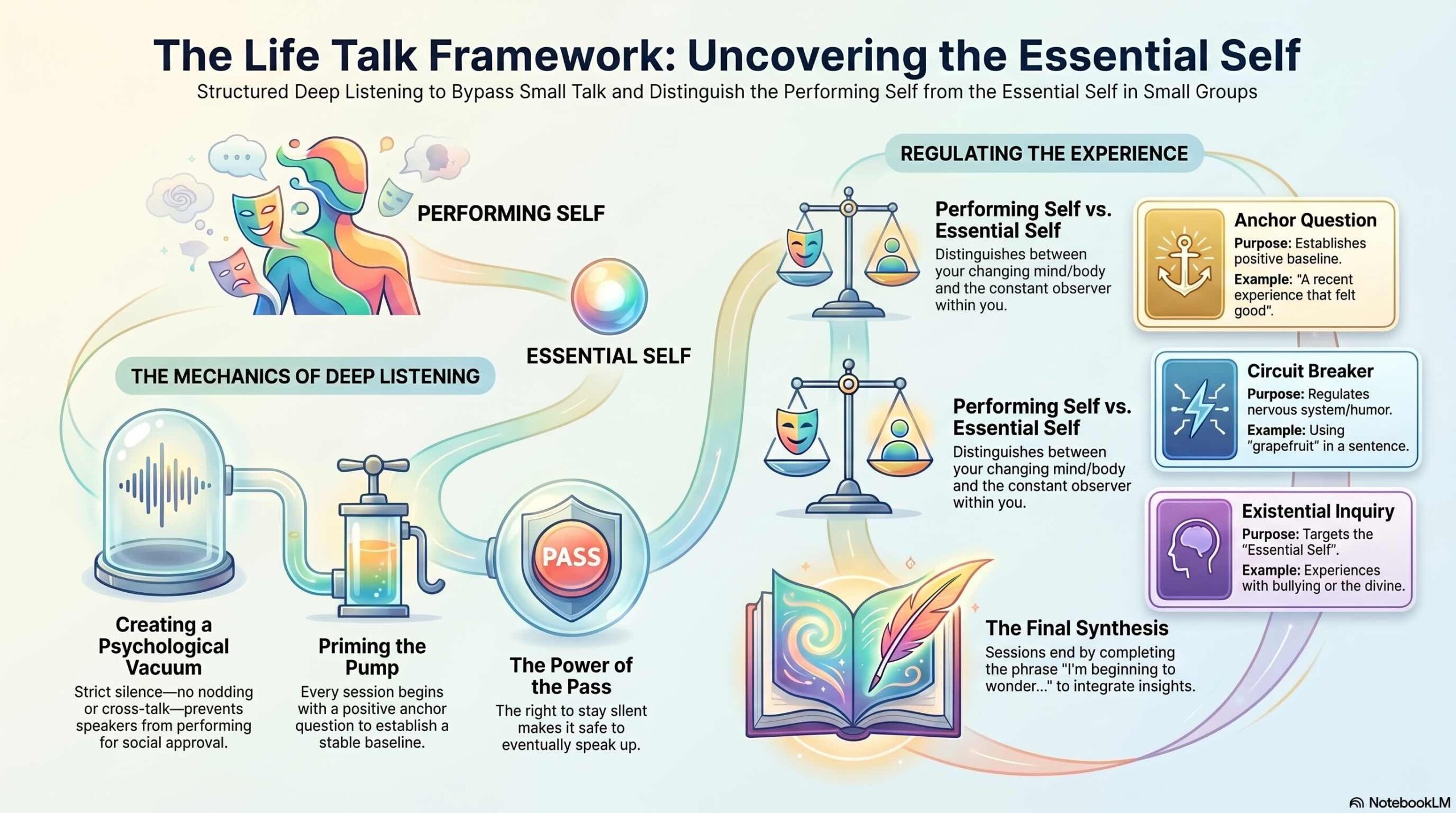
Generated by NotebookLM.Google.com, based on the content of facilitator.one:


The ai screwed up a little on the above explainer video, it is not about a 100 day program…
What’s this all about, according to Gemini?
Ai’s response, based on Assorted Questions, 000 v.28:
The provided document, titled “Life-Talk: For Inspiring Conversations,” is a guide for volunteer group facilitators to lead discussions focused on personal reflection and deep listening. It provides a structured procedure for group meetings and a comprehensive list of daily questions intended to spark meaningful dialogue.
Deep Listening Procedure
Facilitators are instructed to ensure participants understand and follow specific group norms:
- Voluntary Participation: Participants are encouraged to answer honestly but always have the right to pass on any question.
- Silence and No Crosstalk: Only the person “holding the stick” speaks; all others remain quiet, offering unhurried and non-judgmental attention.
- Privacy: Everything shared within the group must remain confidential.
- Facilitator Role: The facilitator reads the question, calls on members, and acknowledges each response with a “Thank you” without rushing the process. They also remind the group to stay silent when it is not their turn to speak.
Meeting Structure
The document suggests an ideal group size of three to seven people. Meetings generally follow this format:
- Daily Questions: Facilitators typically go through a list of questions in order.
- Theme Questions: Alternatively, facilitators can use focused “Theme Questions” found on the life-talk.org website.
- Consistent Opening: Nearly every daily list begins with the same question: “What is a recent experience of yours that felt good to you?”.
- Word Creativity: Most lists include a prompt to create a statement or question using a specific word, such as “fizzle,” “capitalism,” or “saucy”.
- Final Review: Every meeting ends with a “Final Review Question,” asking participants what they learned or found useful using prompts like “I liked…” or “I’m beginning to wonder…”.
Types of Questions Asked
The questions cover a broad range of personal and philosophical topics:
Relational and Social: Handling difficult people, the importance of listening, and views on controversial social issues.
Personal Experiences: High points of life, difficult decisions, and times of feeling ignored or appreciated.
Preferences and Habits: Favorite desserts, hobbies, and methods for breaking bad habits.
Self-Reflection: Strengths and weaknesses, introversion versus extroversion, and life purposes.
Philosophical and Spiritual: The existence of a higher being, the nature of the soul or spirit, and the meaning of wisdom or truth.
This website is a commitment device, a rough draft, a note to self; in memory of Merrill Harmin.
Please help me to make some sense, for the good of all:
Holger@Friendly-Circles.com